
Building Worlds
And using them to teach kids
I’m obsessed with World Models at the moment. Something about using generative worlds to make education more interactive and fun.
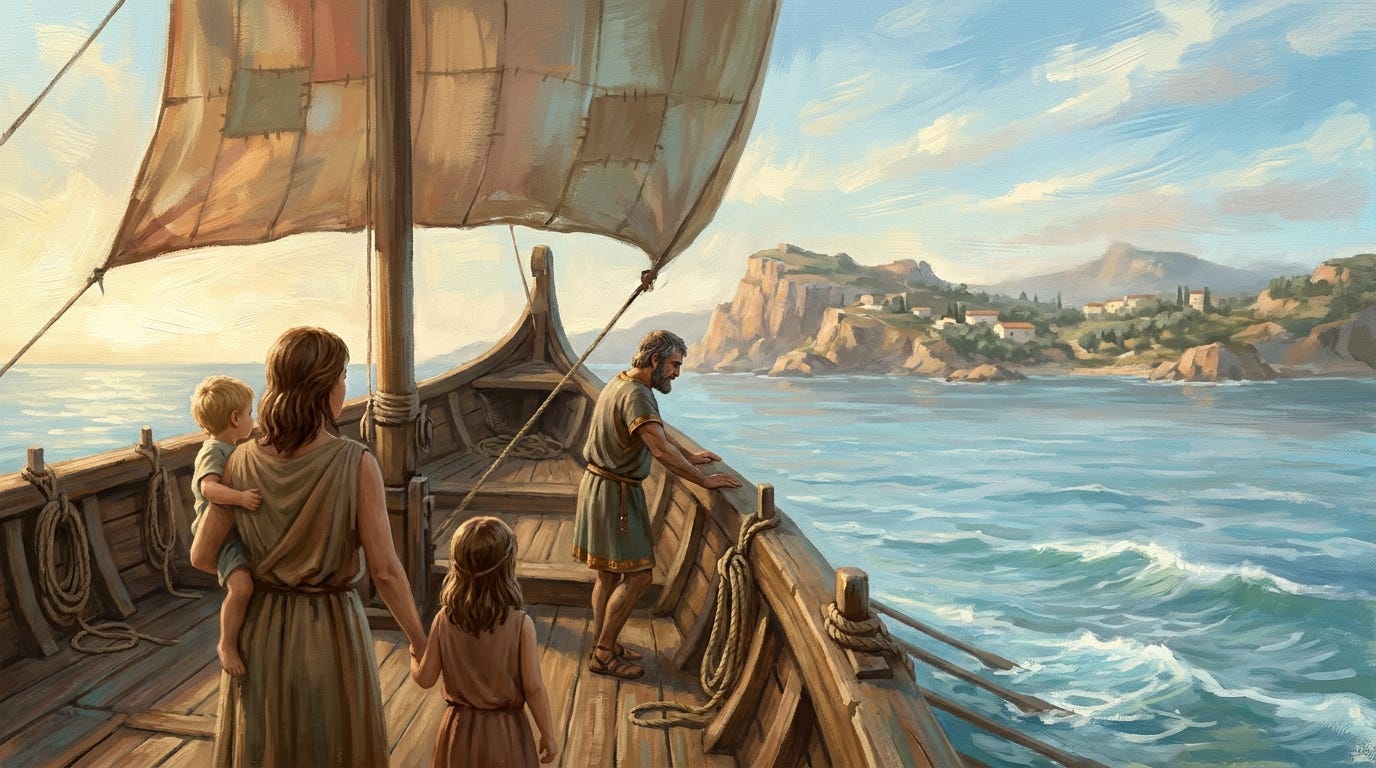
Being able to teach my kids the Greek myths by letting them travel with Odysseus on his way home to Ithaca.
Experiencing Renaissance Florence by sitting in a workshop with Brunelleschi revealing how perspective works while Caravaggio demonstrates chiaroscuro.
Opening their eyes to astronomy in a virtual observatory with Galileo and a cast of historical astronomers illustrating their discoveries.
Watson, Crick, and Franklin explaining the double helix structure of DNA.
I could go on and on and on….
At the current pace of improvement across world model research, I think this will be possible in 18-24 months time.
Here’s an example of that capability jump. This week, Odyssey made three big announcements:

They created a multi-agent model where multiple participants can co-exist in the same simulation. Check out the Goldeneye game on the website.
They also announced Starchild-1, a multimodal model creating audio alongside video:
and PROWL, a new adversarial framework that uses reinforcement learning to stress-test world models. An RL agent roams around a game environment looking for places the physics of the world model fails and gets rewarded for finding the failures.
Each pass makes the world model a bit better, which then makes the RL agent sharper at finding the next round of failures. This creates a closed-loop cycle of feedback, accelerating model improvement.
Education is an exciting area, but this could also meaningfully accelerate capability for adaptive robots.
Links
I have a great story of being blown away by 140km/h winds on the track to Torres del Paine and ending up in hospital:


Energy equipment demand is out of control:


In the US, AI will likely add ~$37–100B per year in intended philanthropic spend in the near future:
Young founders are under-rated. I loved this with the founder of Neo:
The first AI-generated feature film:

Richard Sutton, why LLMs aren’t the future in 26 words:

If you can evaluate correctly, you can train correctly. Lun Wang, a researcher at DeepMind who recently left, published this on the day he announced his departure. Capable evals becomes critical for safety and alignment as model capability continues to scale:

Tracks
Some classic Boiler Room sets this week: